Why Workforce Development Is Key to Breaking Generational Poverty
Breaking generational poverty requires more than short-term solutions. It requires systems that create long-term economic mobility.
For decades, research has shown that poverty in the United States is not just persistent. It is often passed from one generation to the next. Where someone is born, grows up, and lives has a measurable impact on their ability to move up the economic ladder. In fact, economic mobility varies widely not just by state, but by neighborhood, with deeply segregated communities experiencing significantly lower mobility outcomes.
The trend lines are sobering. According to Opportunity Insights, only about 50% of children today earn more than their parents, a dramatic decline from 90% in the 1940s. This is not simply a question of effort. It is a question of access, and in many cases, geography. In states like Georgia, where economic growth is strong but uneven, that gap between opportunity and access continues to shape outcomes for families across generations.
The Reality of Generational Poverty in America
Generational poverty is not just persistent. It is patterned. Research from the Brookings Institution shows that poverty often extends across multiple generations, with significant disparities in who is able to move out of it. Among adults in their 30s, more than half of Black individuals grew up in families in the bottom fifth of the income distribution, compared to just 12 percent of white individuals.
And the challenge is not just where families start. It is how difficult it is to move up. Even when starting at the same income level, upward mobility is far less likely for some families. Brookings research shows that only 37% of Black parents who were raised in poverty moved out of the bottom income tier, compared to 66 percent of white parents. At any given time, approximately 10 million children in the United States are growing up in families living below the poverty line.
These patterns highlight a critical truth. Poverty is not only about income. It is about access to opportunity, exposure to networks, and the systems that either support or limit upward mobility over time.
Why Employment Alone Doesn’t Solve Poverty
For many families, getting a job is not enough to change their trajectory. Low-wage roles without clear pathways for advancement often keep individuals in a cycle of financial instability. A “work-first” approach, placing people into any available job as quickly as possible, may address immediate need, but it rarely leads to long-term progress.
Workforce research increasingly points to a different conclusion: career pathways matter more than job placement alone.
As the National Skills Coalition emphasizes, sustainable workforce systems must focus on long-term growth, not just immediate employment. Similarly, research from McKinsey highlights the urgent need for skills-based hiring and upskilling, noting that as many as 12 million workers may need to transition into new occupations by 2030 to remain competitive in the labor market.
Without intentional pathways to higher-wage, in-demand careers, many workers risk being left behind. The takeaway is clear. Getting a job is step one. Getting a livable wage career is what changes a family’s future.
Workforce Development as a Proven Pathway to Economic Mobility
Workforce development programs are uniquely positioned to bridge this gap. By combining job training, industry-recognized credentials, and direct employer connections, these programs create pathways into stable, higher-paying careers. Data from the U.S. Department of Labor shows that individuals who complete apprenticeship programs can earn significantly more over their lifetime, in some cases, as much as $300,000 more than their peers. These are not incremental gains. They are life-changing outcomes.
More importantly, they are generational. Increased earning potential doesn’t just impact one individual. It shapes opportunities for children, families, and entire communities. In Georgia, where key industries such as logistics, healthcare, and construction continue to grow, workforce development is not just about filling jobs. It is about preparing residents to access and sustain those opportunities.
The Missing Link: Wraparound Support
Even the most effective training programs can fall short if they don’t address the realities people face outside the classroom or workplace.
Research from organizations like the Annie E. Casey Foundation and MDRC shows that workforce programs are most successful when paired with wraparound services, support systems that address barriers like food insecurity, housing instability, and access to transportation. The truth is simple: It is difficult to focus on career growth when basic needs are unmet.
This is particularly relevant in communities across South DeKalb and metro Atlanta, where families may be balancing multiple challenges while trying to pursue employment opportunities. Holistic, community-based approaches that address both economic and personal barriers are not an added benefit. They are a necessity.
The Broader Impact: Strengthening Local Economies
Workforce development doesn’t just change individual outcomes. It strengthens entire communities. When individuals gain access to higher wages and stable employment, reliance on public assistance decreases, local spending increases, and businesses benefit from a more skilled workforce. Even modest wage increases can significantly reduce dependence on income-support programs, creating a ripple effect across the local economy.
In regions like Georgia, where economic growth and workforce demand continue to evolve, investing in workforce development is not just a social good. It is an economic strategy. It builds stronger communities, more resilient families, and more competitive local economies.
As the state continues to attract new industries and expand existing ones, the demand for skilled workers is growing. Workforce development ensures that local residents are not only included in that growth, but positioned to benefit from it. This is how economic mobility scales, not just person by person, but community by community.
From Research to Reality: A Local Model That Works
At New Life Community Alliance (NLCA), this approach is already in action.
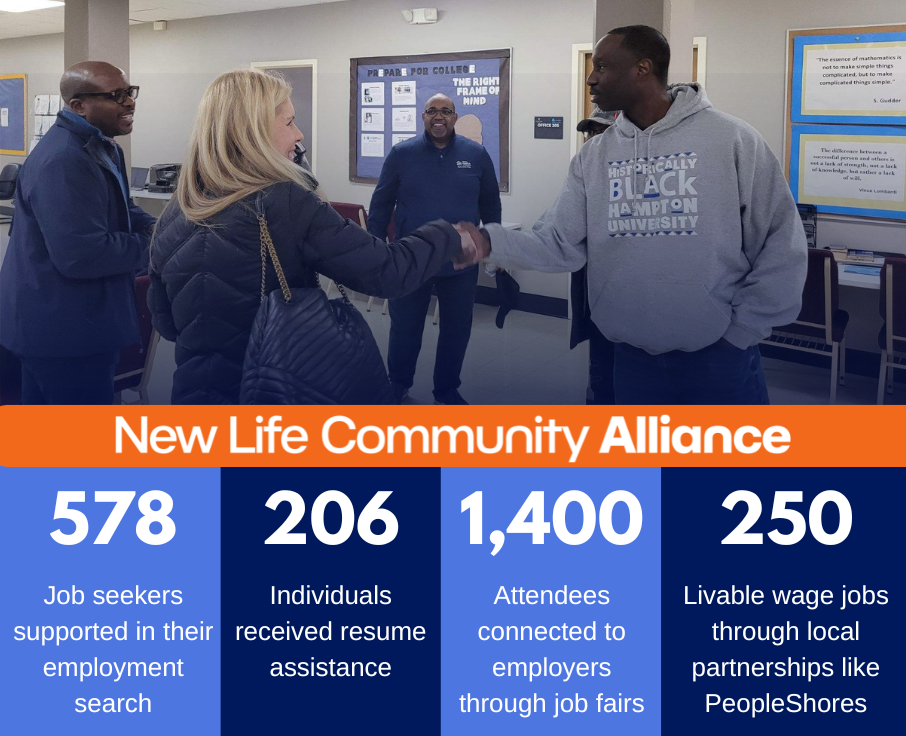
As a workforce development nonprofit serving South DeKalb, NLCA combines career services, job training, and wraparound support to help individuals move from instability to opportunity. In the past year alone, NLCA has supported 578 job seekers in their employment search, provided resume assistance to 206 individuals, and connected more than 1,400 attendees to employers through job fairs.
Through partnerships like its collaboration with PeopleShores, NLCA is also working to create more than 250 livable wage jobs directly within the community – expanding access to opportunity where it is needed most.
This is what workforce development looks like when it is done well. Development is not just a single program or a one-time intervention. Real workforce development is a coordinated system designed to move people forward.
Building a Future Defined by Opportunity
For funders, partners, and community leaders, the implications are clear. If the goal is to break cycles of poverty, investment must go beyond short-term relief and toward long-term solutions that create economic mobility. Workforce development is one of the most effective ways to do that. It delivers measurable outcomes. It strengthens communities. And it creates lasting change that extends across generations.
Generational poverty is complex. But it is not unchangeable. With the right investments, the right partnerships, and the right strategies, communities can create pathways to opportunity that did not exist before. Workforce development is one of those strategies. When access meets action, the results speak for themselves.